


Review: Mortal Kombat II (2026)


Mortal Kombat II is one of the most baffling blockbuster experiences I’ve had in recent memory. A movie that somehow manages to squander a globally beloved franchise, a charismatic cast, and the sensory potential of IMAX spectacle all at once. I saw the film at IMAX Sydney, and quite frankly, the sound design was the only aspect of the experience that actually justified the premium format. The bass rattled the room, the impacts had genuine force, and certain moments carried the kind of earth-shaking sonic presence you want from a Mortal Kombat movie. Unfortunately, all of that technical thunder is attached to a film that feels creatively hollow from top to bottom.
What shocked me most about Mortal Kombat II is just how lifeless it feels. This is a franchise built on brutality, energy, style, and absurd mythological chaos, yet the film plays out with the sterile artificiality of a streaming-series placeholder. Nearly every scene feels as though it was shot separately, on disconnected soundstages, with actors rarely appearing to inhabit the same physical space. There’s no sense of geography, no atmosphere, no tactile world-building. Instead, the movie constantly resembles actors standing in front of giant LED walls while digital environments collapse around them in post-production.

And the CGI is genuinely awful. Not “occasionally rough” blockbuster CGI. Not “unfinished in places.” I mean consistently weightless, synthetic, immersion-breaking visual effects that drain every fight and every environment of impact. Characters move through digital sludge that never convinces as a real location, and the action becomes exhausting because there’s nothing tangible to latch onto. Explosions feel fake. Blood effects feel fake. Entire backgrounds feel unfinished. There are moments where the film resembles a high-budget cutscene rather than a theatrical feature. For a series that should feel grimy, tactile, and savage, Mortal Kombat II instead looks glossy in the worst possible way: overly processed, overlit, and completely divorced from physical reality.
The most unforgivable aspect, though, is the action itself. How do you make Mortal Kombat boring? That sounds impossible on paper, yet the film somehow accomplishes it repeatedly. The fight scenes are astonishingly dull: repetitive choreography, endless cutting, no rhythm, no escalation, no memorable visual storytelling. Characters punch, kick, teleport, throw CGI energy around, and then the scene just… ends. Again and again. There’s no tension because the movie never establishes stakes, and there’s no excitement because the choreography lacks creativity. The fights blur together into one long montage of interchangeable digital noise.
To me, a great martial arts film understands space, timing, and momentum. Even the best moments from the 2021 Mortal Kombat at least attempted to give certain confrontations identity and brutality. Here, every fight feels algorithmically assembled as if the filmmakers assumed audiences would simply clap because recognizable characters are on screen. Instead of visceral combat, we get lifeless spectacle.
Which leads directly into the film’s biggest issue: it barely has a plot. Calling the story thin would be generous. The movie doesn’t feel structured so much as stitched together. Characters appear, exposition is dumped, another fight happens, then the film lurches forward to the next sequence with almost no dramatic connective tissue. Nothing builds. Nothing develops. There’s no emotional core, no meaningful character arcs, and no sense that the screenplay has any interest in coherence beyond getting to the next reference for fans to recognize.
The film constantly mistakes familiarity for storytelling. It assumes that because audiences know these characters from the games, the movie doesn’t actually need to do the work of making us care about them here. But nostalgia and recognition are not substitutes for narrative momentum.
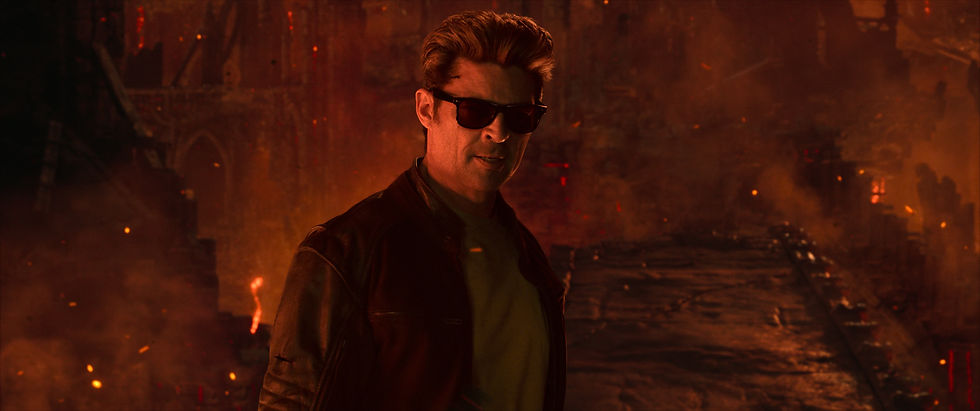
Onto the film's lead, Karl Urban. Urban is one of those actors who can elevate almost anything through sheer presence alone. He brings grit, charisma, and a wonderfully dry edge to so many roles, and on paper, he feels like inspired casting for this universe. But Mortal Kombat II gives him absolutely nothing to work with. His performance feels stranded inside a movie that doesn’t understand how to utilise actors beyond having them deliver exposition and pose dramatically before another CGI-heavy battle sequence begins. You can almost sense him trying to inject personality into scenes that are otherwise completely inert.
That’s perhaps the strangest thing about the film overall: despite the chaos happening onscreen, it feels emotionally dead. There’s no passion behind it. No madness. No genuine sense of fun. A franchise like Mortal Kombat should embrace excess — it should be stylish, vicious, ridiculous, and entertainingly unhinged. Instead, this feels like content engineered in a corporate lab. Loud, expensive, empty content.
And yes, the movie is braindead.
Not in the fun, midnight-movie way where you can surrender to the insanity and have a blast. Not in the gleefully trashy way that makes bad genre films entertaining. This is the exhausting kind of braindead — a film so mechanically assembled and dramatically vacant that it becomes numbing. Scene after scene crashes into the next without purpose or imagination, until eventually the endless barrage of CGI and noise simply becomes tedious.
Ironically, the IMAX presentation only amplified the problems. The incredible sound mix made me wish the visuals and storytelling were worthy of the same scale. You could feel the sonic power of the movie in your chest, but there was nothing onscreen to emotionally or visually match it. It became a perfect metaphor for the film itself: enormous volume masking complete emptiness underneath.
There’s a version of Mortal Kombat II that could have worked. One that embraced practical environments, inventive choreography, stylised violence, and unapologetic B-movie insanity. Instead, what we got is a visually ugly, narratively vacant, and astonishingly tedious blockbuster that mistakes noise for excitement and recognisable IP for actual filmmaking.
For a franchise built on delivering knockout blows, this one barely lands a hit. Flawless victory? Please.
1/5.


Comments